




News
Fire-safe greenery: increasingly a requirement

More and more clients set fire safety requirements for artificial planting. Care facilities, schools, hotels, offices and exhibition halls now look at greenery as critically as at curtains and wall coverings. Rightly so, because what hangs on walls and ceilings helps decide how fast a fire spreads. We hear that some clients are switching back to live plants for this reason. There is no need. In this article we set out which rules apply, what the fire classes mean and how to bring greenery into a space without risk.
By Rinze de Leeuw and Lennard Duijvestijn of Coolplant. Lennard has been a building acoustics consultant since 1996, a field where the fire classes of wall and ceiling materials come up in every project.
Why greenery matters in a fire
In a fire, every minute counts. The American testing institute UL furnished living rooms with furniture from the 1950s to 1970s and with new furniture from the shop, and set them alight. The modern rooms were fully ablaze within five minutes, the older rooms only after about 29 minutes. The difference was the material: plastics release their energy much faster than wood, cotton and wool.
Artificial plants are made of plastic too. An ordinary artificial plant can melt and drip while burning, and a plant wall or a ceiling full of hanging greenery is a large surface. How big a role decoration can play became painfully clear in the Netherlands on New Year’s night 2001. In café ’t Hemeltje in Volendam, Christmas decorations on the ceiling were set alight by sparklers; fourteen young people died and more than two hundred were injured. The investigating committee found that the decorations hung too low and were highly flammable. The rules for fire-safe use of buildings were tightened considerably afterwards. In early 2026, more than forty people died in a bar in Crans-Montana, Switzerland; according to the first findings, sparklers there also reached the ceiling, which was lined with sound-insulating foam. That investigation is still ongoing.
What the rules in the Netherlands require
Since 1 January 2024, the rules for the use of buildings in the Netherlands have been set out in the Besluit bouwwerken leefomgeving (Bbl). Anything that hangs or stands in a room as decoration counts as furnishing there. Three articles matter for artificial greenery:
- No fire hazard (article 6.14). Furnishings must not create a fire hazard. For greenery that is not on the floor, such as a plant wall, hanging plants or greenery above a bar, this means: the material is non-combustible, or it meets the same fire class that applies to the walls and ceilings in that room. Only a very small amount that barely contributes to a fire is exempt.
- No burning droplets (article 6.24). Furnishings above a floor where people walk must not drip when burning. That is exactly what the d0 in a Euroclass is about.
- Clear escape routes in residential buildings (article 6.15a). In shared corridors and stairwells of residential buildings that form part of an escape route, only non-combustible decoration is allowed: metal, stone, glass or class A1. So no artificial plants there, not even fire-retardant ones. If you would still like to make such a corridor more welcoming, we are happy to think along about other solutions.
Which fire class the walls and ceilings in your space must meet depends on the building and the location. It is stated in the permit or the fire safety plan of the building. If you are unsure, ask your fire safety consultant, installer or the fire service. We are glad to help translate that into the right greenery.
At trade fairs and events
Rules are getting stricter at trade fairs in particular. Stand builders tell us that some venues now only allow real plants, while others accept artificial plants if they are demonstrably fire-retardant. Two examples from the regulations:
- RAI Amsterdam allows artificial plants if they achieve fire propagation class 2 under the older Dutch standard NEN 6065; otherwise only to a very limited extent. Under the Bbl, class 2 indoors corresponds to Euroclass B. The RAI also notes that cut flowers dry out during a fair and then burn more easily.
- Messe Frankfurt requires artificial plants to be flame-retardant (DIN 4102 B1 or the European equivalent), not to drip while burning, and a copy of the proof to be kept at the stand. The fair announced additional inspections; anything that does not comply must be removed immediately.
There are rules for live greenery as well. The German Versammlungsstättenverordnung states that natural plant decoration may only remain in a room while it is fresh. So check the venue’s regulations in advance and bring the certificate. In practice our certificates are almost always accepted. For a stand in Germany, show the certificate to DIN 4102-1 (B1); for the United Kingdom we also have a certificate to BS EN 1021-1 and -2.
In healthcare
In hospitals, hygiene matters alongside fire safety. In its guideline on infection control, the US Centers for Disease Control and Prevention (CDC) advises against allowing flowers and potted plants in areas for severely immunocompromised patients. Potting soil and flower water can contain moulds such as Aspergillus, which are dangerous for these patients. Artificial plants need no soil and no water. They do need to be easy to keep clean, so regular dusting is part of the deal. If in doubt, always ask your own infection prevention team.
Why greenery, and why artificial
Greenery does something to people. In three field experiments in Dutch and English offices, researchers found that employees in offices with plants rated the air as better, could concentrate better, were more satisfied and got more work done than in bare offices. That study was about live plants. A recent review of research on artificial plants shows that artificial greenery also has a positive effect compared with no greenery, although the effect is usually smaller than with live plants. So the honest answer is: live greenery works a little better, but where live greenery is not possible or not allowed, good artificial greenery is far better than nothing.
And there is a practical side. Live plants are often single-use: after a fair, event or season they are thrown away and you buy again. Fire-retardant artificial plants can be used time after time. They need no water, light or maintenance and stay beautiful for years, even in places where live plants struggle.
What fire-retardant means at Coolplant
In Europe, materials are classified under the standard EN 13501-1, from A1 (non-combustible, such as stone and glass) to F. A class consists of three parts. Our fire-retardant range has been tested to B-s2,d0:
- B: very limited contribution to the fire
- s2: medium smoke production (s1 is low, s3 high)
- d0: no burning droplets or particles
The material has also been tested to the German standard DIN 4102-1 and achieves class B1: flame-retardant. The fire retardancy is in the material itself; it is not a coating that wears off over time. Each product states whether it is fire-retardant. We send the certificate for your products with the quotation or delivery, so you can add it to your fire safety file. This also lets you meet the requirements that are increasingly set in specifications and inspections.
Where the rules stop
A certificate does not make a space safe by itself. Keep greenery away from spotlights, heaters and other heat sources, keep escape routes clear and leave candles and sparklers out of decorations. The rules are a minimum. What matters to us is a space where people feel good and where you have nothing to worry about. You do not have to choose between a warm, green space and a safe one.
Advice for your project
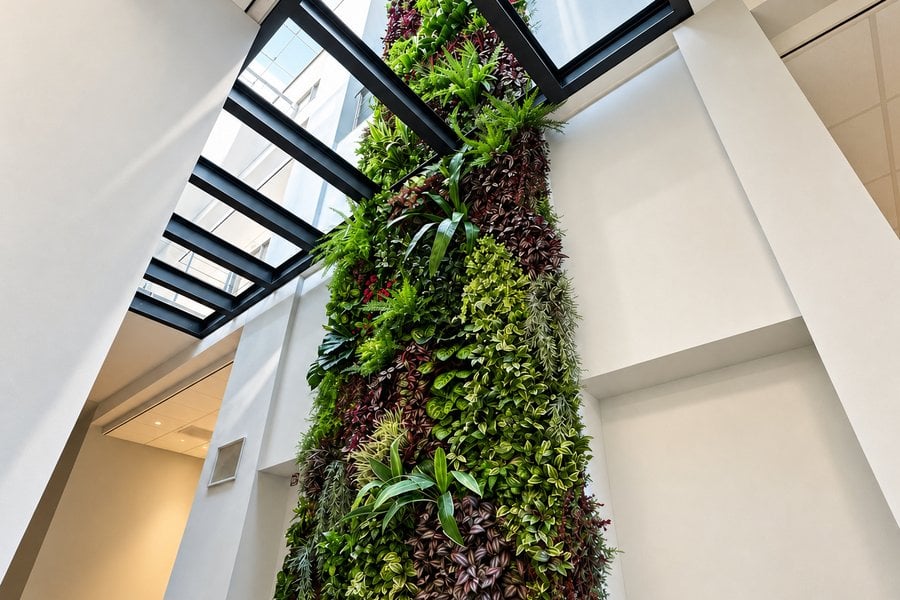
Not sure which requirement applies to your project? We are happy to help, from a single plant in a consulting room to a complete plant wall in an atrium. Call us on +31 85 13 09 155 or email [email protected].
Take a look at our fire-retardant artificial plants.
Frequently asked questions
What fire class does Coolplant’s fire-retardant artificial planting have?
Our fire-retardant range has been tested to EN 13501-1 (Euroclass B-s2,d0) and DIN 4102-1 (class B1).
Do I get a certificate for my fire safety file?
Yes. We send the certificate for your products on request with your quotation or delivery.
What do s2 and d0 mean?
The s refers to smoke: s2 means medium smoke production. The d refers to droplets: d0 means that no burning droplets or particles fall in a fire.
Do you have a certificate for the United Kingdom?
Yes. Besides EN 13501-1 and DIN 4102-1, we have a certificate to BS EN 1021-1 and -2.
Are live plants safer?
Not automatically. A fresh plant with a moist root ball burns poorly, but cut flowers and plants that dry out actually burn more easily. That is why some regulations only allow live greenery while it is fresh.
Do fire-retardant artificial plants look different?
No. They look just as natural as our standard range; the difference is in the tested material.
Can I use fire-retardant artificial plants outdoors?
Part of the fire-retardant range is also UV-resistant and suitable for outdoor use. This is stated for each product.
Sources
- Besluit bouwwerken leefomgeving (Dutch Buildings Decree), articles 3.35, 6.14, 6.15a and 6.24 (in force 1-1-2026). wetten.overheid.nl/BWBR0041297
- Informatiepunt Leefomgeving (IPLO). Limiting danger and injury: furnishings. iplo.nl
- EN 13501-1:2018. Fire classification of construction products and building elements, part 1: classification using data from reaction to fire tests.
- DIN 4102-1:1998. Fire behaviour of building materials and building components, part 1: building materials; concepts, requirements and tests.
- RAI Amsterdam. Fire Service Regulation (Annex 1 to the Facility Regulations), art. 5.9. rai.nl
- Messe Frankfurt Venue GmbH, Technical Event Management (2024). Factsheet on combustible stand construction materials. messefrankfurt.com
- Versammlungsstättenverordnung (German places of assembly regulation), § 33 (decorations), for example the Brandenburg version. haufe.de
- Kerber, S. (2012). Analysis of changing residential fire dynamics and its implications on firefighter operational timeframes. Fire Technology 48(4). UL summary: ul.com
- Commissie Onderzoek Cafébrand Nieuwjaarsnacht 2001 (Alders committee) and government response, parliamentary paper 27 575, no. 5. officielebekendmakingen.nl
- Swissinfo (January 2026). Crans-Montana bar fire. swissinfo.ch
- Sehulster, L. and Chinn, R.Y.W. (2003). Guidelines for Environmental Infection Control in Health-Care Facilities. CDC and HICPAC, MMWR 52(RR-10), section Flowers and Plants in Patient-Care Areas. cdc.gov
- Nieuwenhuis, M., Knight, C., Postmes, T. and Haslam, S.A. (2014). The relative benefits of green versus lean office space: three field experiments. Journal of Experimental Psychology: Applied 20(3): 199–214. doi.org/10.1037/xap0000024
- Kritayopas, P. and Anambutr, R. (2025). Methodological review of artificial plants as meaningful stimuli in environmental psychology. Sarasatr: Journal of Architecture and Design 8(4). tci-thaijo.org


